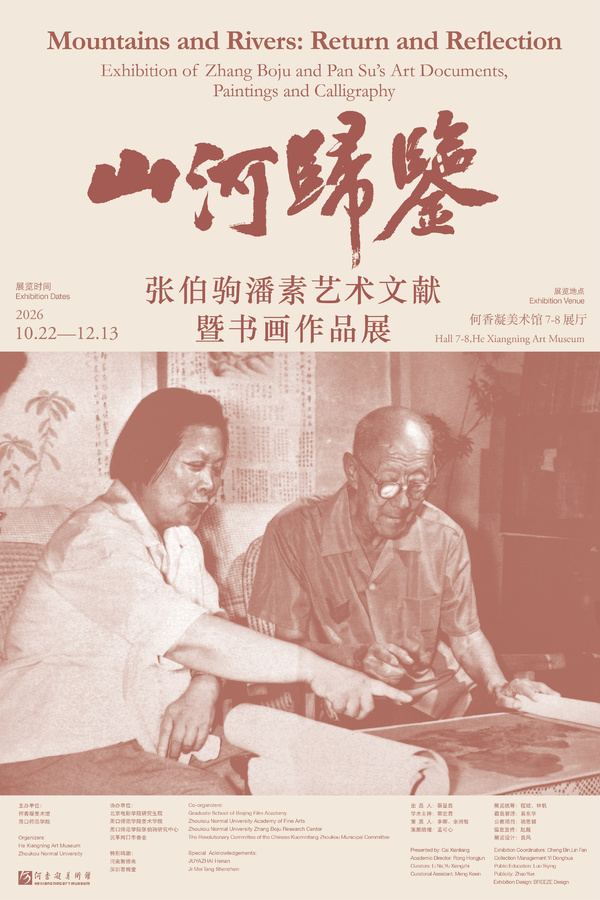
Exhibition Dates
2026.10.22 To 12.13
Exhibition Venue
He Xiangning Art Museum Hall 7—8
Organizers:He Xiangning Art Museum,Zhoukou Normal University
Co-organizers:Graduate School of Beijing Film Academy,Zhoukou Normal University Academy of Fine Arts,Zhoukou Normal University Zhang Boju Research Center,The Revolutionary Committee of the Chinese Kuomintang Zhoukou Municipal Committee
Special Acknowledgements:JUYAZHAI Henan,Ji Mei Tang Shenzhen
Amid national turmoil, cultural relics were scattered and lost. Who would safeguard the unbroken thread of Chinese scholarship and culture? In the first half of the 20th century, China oscillated between upheaval and renewal, grappling with urgent questions: How shall the nation survive? How shall its cultural heritage endure?
At a time of national peril, Zhang Boju and Pan Su stepped forward. They spent their family fortune to rescue national treasures, enduring countless dangers yet remaining steadfast in protecting these relics. When peace returned to the land, they donated their lifelong collection to the state, transforming private treasures into shared national heritage. They fulfilled their aspiration: “What I have collected need not remain mine forever.” “Forever in our homeland, handed down in orderly succession.” Their extraordinary feat perpetuates the Chinese cultural lineage.
In the Beijing art circle of the 1950s, the couple forged close ties with He Xiangning through salon gatherings, collective painting sessions, and public welfare charity sales. Records of group paintings led by He Xiangning, rosters for charity sales to support troops during the War to Resist U.S. Aggression and Aid Korea, and archives of the Beijing Chinese Painting Research Association preserve historical traces of the three figures sharing the same cultural space. He Xiangning expressed her aspirations through paintings of tigers and plum blossoms, her brushwork imbued with unyielding integrity. Zhang Boju excelled in connoisseurship, poetry, calligraphy, painting and opera, with profound vision within his breast. Pan Su inherited the tradition of Tang blue-and-green landscape painting, rendering graceful mountains and rivers with her brush. The three shared affiliations with The Revolutionary Committee of the Chinese Kuomintang (RCCK); they cherished traditional Chinese painting; they were united in their devotion to preserving Chinese culture. This forms the intrinsic rationale for hosting this exhibition at He Xiangning Art Museum. He Xiangning Art Museum has long dedicated itself to academic research on the development of modern and contemporary Chinese art. Centered on the artworks and documents of Zhang Boju and Pan Su, this exhibition transcends a mere biographical narrative of individuals. It returns to the historical context and examining how traditional arts and literature, having weathered turbulent times, became part of the process of modern national cultural construction is highly beneficial for gaining a deeper understanding of the history of modern Chinese art.
He Xiangning once wrote in a poem:For whom does one mend a broken land?Mists and clouds beneath my brush are by no means idle.These lines capture the shared resolve of that generation of intellectuals: to mend the broken nation with brush and ink, and to entrust their patriotism to painting. Today our land is safe and peaceful, and our cultural heritage flourishes. In this prosperous age, we ought to remember the legacy of these predecessors, carry forward their aspirations, and glorify Chinese culture.
The forebears are gone, yet their integrity endures. Reflecting on the past guides us toward the future; we must not forget history.
Land restored to its guardians, cultural veins ever renewed. The torch passes onward, entrusted to us today.